
What’s the Difference Between a Lob Wedge and Sand Wedge?
The main difference a lob wedge and sand wedge is that a lob wedge has a loft of 60° to 64°, while a sand wedge has a loft of about 52° to 58°
The lob wedge and sand wedge are used for different purposes. A lob wedge is used to make shots that rise high quickly, such as shots to get over trees while a sand wedge is used specifically for hitting shots out of sand traps easily.
However, both the lob wedge and the sand wedge can be used for different purposes other than those main functions. The sand wedge is noticeably more versatile than the lob wedge though.
When Should You Use a Lob Wedge?
Lob wedges are typically used to make shots that rise in the air quickly. They can help you consistently hit your golf ball close to the flag from about 50 to 60 yards out.
This means the lob wedge is perfect to use to get your ball to the flag – all the way from the other side of a sand trap!
Lob wedges help you hit the shot high while imparting enough backspin to make your golf ball stop quickly. They’re used to make precise shots and should be used around the green.
You should use a lob wedge when you need to make a shot that requires a high trajectory with a soft landing. A small warning; don’t use a lob wedge when there’s too much green around and other clubs would be a better choice.
Use your lob wedge for shots over high obstacles, to tucked pins, from downhill lies and superfast greens. Use your lob wedge for shots where loft is the primary requirement.
When Should You Use a Sand Wedge?
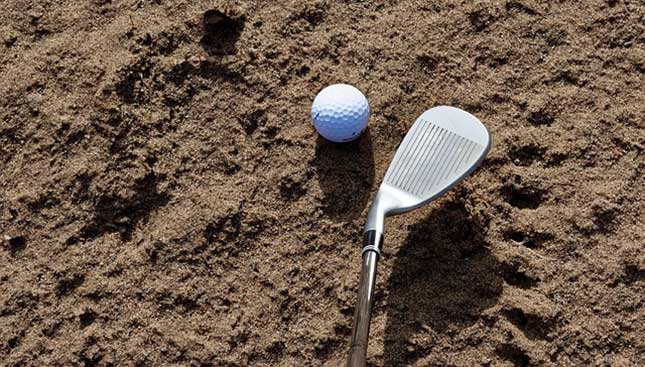
Sand wedges are typically used to get out of sand traps and bunkers. They’re very useful in the sand because of the bounce they offer.
A sand wedge has a much higher angle than normal which produces more bounce. This extra bounce is what helps you get under your golf ball and get right out of whatever sand trap or bunker you’re trapped in.
You can expect a distance of 70 to 100 yards at a full swing when using a sand wedge.
You should use a sand wedge when faced with the dreaded sand bunkers but you can also use your sand wedge to make shorter approach shots. Sand wedges are useful to make shots closer to the green.
You can also use your sand wedge when faced with rough lies, firm lies, downhill lie and a plugged golf ball.
A word of caution; don’t use your sand wedge on firm, compacted sand or hard ground.
The extra bounce is a disadvantage on these surfaces. It may cause you to strike your golf ball near the middle, thus messing up your shot. In this case, I recommend using other wedges like the pitching wedge.
Does a Beginner Need a Sand Wedge?
Yes, a beginner absolutely should have a sand wedge. A sand wedge is a necessity for beginners to play even halfway decently when they get stuck inside sand traps and bunkers.
The sand wedge is the first specialty wedge a beginner should add to their golf bag.
Wedges are typically for specialty shots but a specialty shot every golfer will need to make is a shot to get out of sand banks.
The sand wedge is a lifesaver when you get stuck in the sand regardless of how good a golfer you are.
A beginner absolutely needs a sand wedge in their bags.
Another reason that beginners should have a sand wedge is their versatility. While they’re main purpose is to get your golf ball out of sand traps, they can also be used for things like short approach shots.
Does a Beginner Need a Lob Wedge?
No, a lob wedge is the last club a beginner should add to their bag. Beginners should only use a lob wedge after they become good enough with a sand wedge. A lob wedge isn’t necessary for a beginner golfer.
Part of the reason beginners aren’t recommended to add a lob wedge to their arsenal straight away is that a sand wedge can be used for some of the things the lob wedge does.
For example, the sand wedge can be used for short approach shots as well as to get out of sand bunkers. It’s better for a beginner to have a versatile club like the sand wedge at first rather than the specialised lob wedge.
A lob wedge is a wedge for specialty shots and requires extra time as well as practice to master. A beginner is better off spending their time learning the fundamentals of golf or how to escape sand bunkers using a sand wedge.
Furthermore, beginners can use the sand wedge for some of the things a lob wedge does. This means they can practice lob wedge shots using a sand wedge.
Lob Wedge VS Sand Wedge
Lob wedges have a loft of 60° to 64° while sand wedges have a loft of 52° to 58°. Loft is the angle of the club face as it is positioned on the shaft. The different lofts are what give the lob wedge and the sand wedge their unique properties.
Lob wedges usually have a range of about 50 to 60 yards although beginners would be more likely to get 30 yards out of it. Pros however have been known to get 75 to 95 yards out of lob wedges but they’re exceptional cases.
Sand wedges usually have a range of 70 to 100 yards at full swing. It’s been noted that beginners get more distance much easier than when they use a lob wedge while also being able to make short range shots as well.
A lob wedge is used for short approach shots and shots over hazards while a sand wedge is used to make shots out of bunkers as well as high pitch shots.
It should be noted however that a sand wedge can be used to for short approach shots because it’s a versatile club. They’ve actually been used to get shots over hazards as well but that’s not what a sand wedge is made to be used for.
A lob wedge has less and bounce and a high amount of spin but has very short range. A sand wedge on the other hand is quite versatile but is less durable as it tends to be easier to thin.
Lob Wedge Bounce VS Sand Wedge Bounce
The bounce of a wedge is the angle between the sole line and the ground line of a club. Bounce on a wedge is what causes the leading edge to sit slightly off the ground. It stops the leading edge from digging into the ground which allows a club to glide through turf or sand.
A Lob wedge typically has a low bounce of between 4° to 6°. The low bounce makes lob wedges great for use in courses with firm turf conditions as well as bunkers with harder, coarser sand.
However, the low bounce makes it difficult to use a lob wedge to get your ball out of typical sand bunkers with softer sand.
Sand wedges typically have high bounce of more than 10°. The high bounce makes sand wedges great for use in courses with softer turf, fluffy lies as well as bunkers with soft sand. However, the high bounce is a disadvantage at banks with firm, compacted sand or hard ground.
How Much Bounce is there on a Lob Wedge?
The “bounce” of a wedge also refers to the curvy bit on the sole of the wedge that enables the head to “bounce” out of sand or rough without snagging.
Lob wedges usually come with low bounce but can actually come with medium or high bounce as well. Regarding lob wedges, less than 5° is considered low bounce, 6° to 9° is medium and 10°” is a high bounce.
Which lob wedge should you use? If you play at a course with softer ground, use a high bounce lob wedge which improves golfer performance on fluffy land.
If you play at a course with firmer ground, use a low bounce wedge to make the leading edge of the club get to the bottom of the ball on firm turf.
How Many Degrees is a Lob Wedge?
Degrees in this case means loft. Loft is the angle of the club head relative to the club shaft.
A lob wedge typically has a loft of 60° to 64°. This allows the lob wedge to make your golf ball fly about 15% higher than when you’re using a regular wedge.
Lobbing your golf ball high in the air is useful for situations where you want to get your golf ball over a tree or bunker.
How Many Degrees is a Sand Wedge?
Unlike a lob wedge, a sand wedge usually has a loft of 52° to 58°. The loft of the sand wedge helps to propel your golf ball quickly into the air with spin due to the way it’s designed. Of course, this is to make shots to get your golf ball out of sand bunkers easier.
How Long is a Lob wedge?
The length of lob wedges varies and golfers need to get a feel of it themselves to choose the correct length that suits them. It’s like trying to get the right fit on a pair of shoes.
The standard length of a lob wedge is 35.25 inches if it’s made of steel, while a lob wedge made of graphite is 35.75 inches long.
The standard length for a lob wedge for female golfers is 34.25 inches for a steel wedge, and 34.75 inches for a graphite wedge.
How Long is a Sand Wedge?
Like lob wedges, sand wedges are available in a variety of lengths. It’s up to golfers to decide which length of sand wedge is most suitable for them.
Golfers should experiment with different lengths and see which length of wedge improves their game. However, there are standard lengths for sand wedges.
The standard length of a sand wedge made of steel is 35.25 inches, where a graphite made sand wedge is 35.75 inches in length.
The standard length of sand wedge for female golfers is 1 inch shorter than male counterparts. Female golfers should use a steel sand wedge of 34.25 inches, and 34.75 inches for a sand wedge made of graphite.